The Agony of Art
The overworking crisis that plague artists

The overworking crisis that plague artists


"“After working in the L.A. industry for many years, I could see so much money just needlessly thrown down the toilet in making a lot of these movies. It doesn’t have to cost that much money when you’re well organized, and you have your mind set on the goal of what you want to do, and you get the job done with a small, determined crew.” - Greg Tiernan

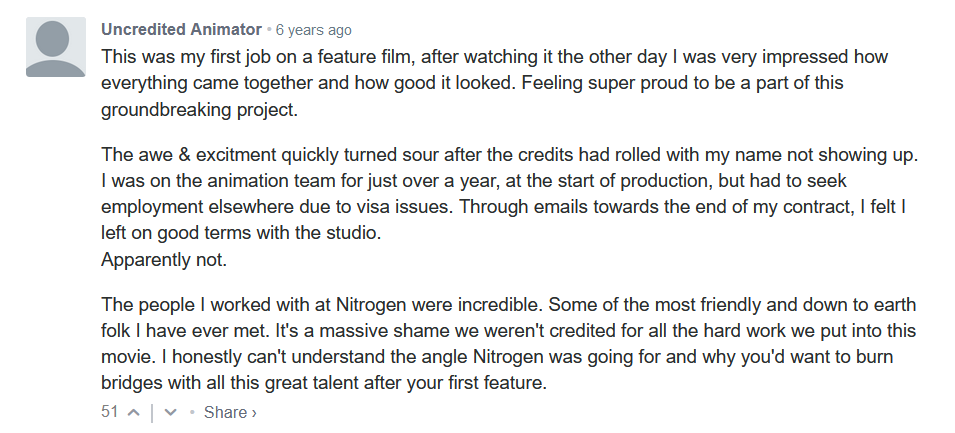
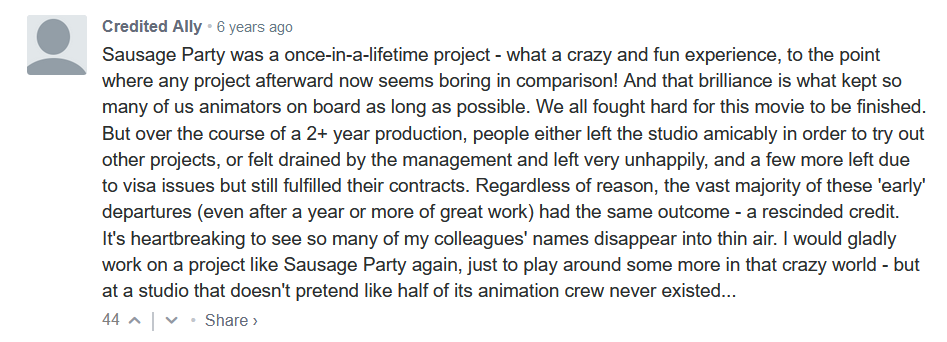
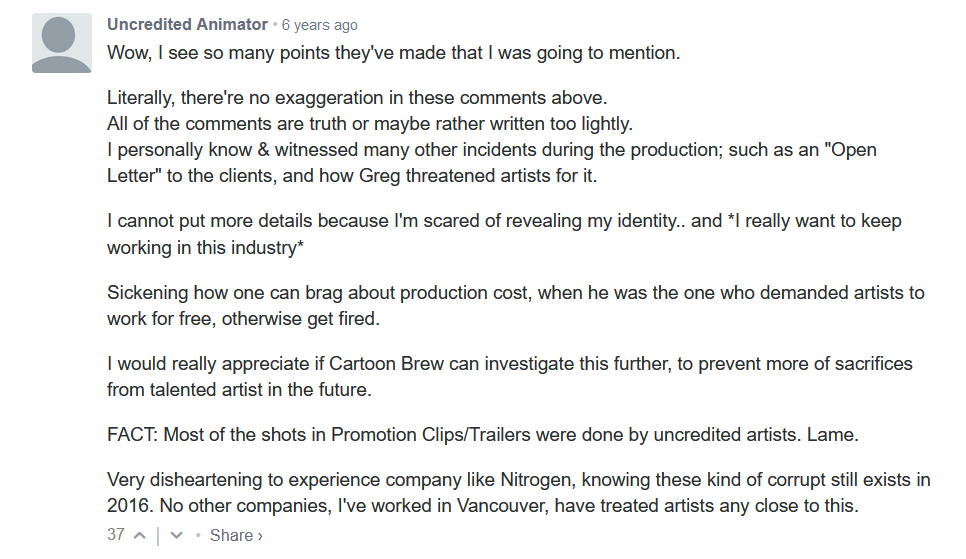
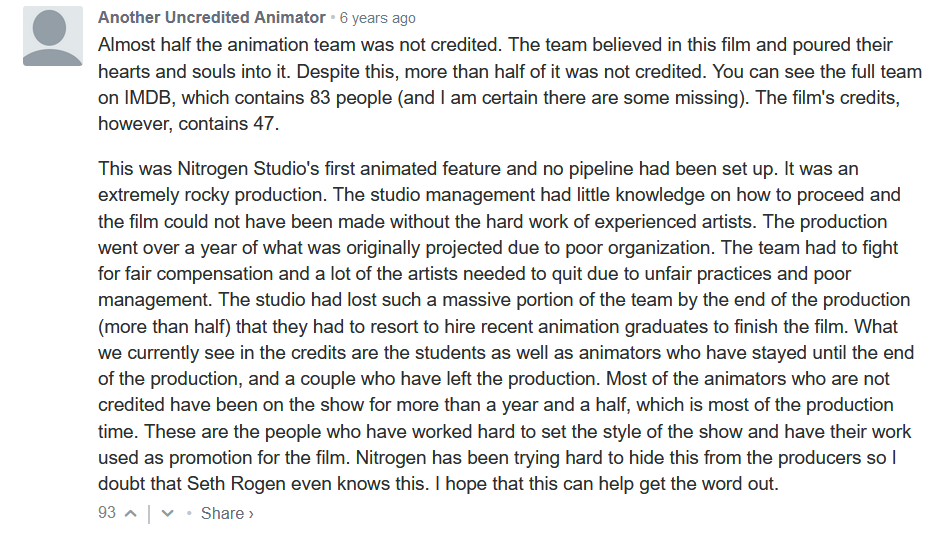
On August 12th, 2016, Cartoon Brew published a Q&A featuring the directors of the movie Sausage Party: Conrad Vernon and Greg Tiernan. This article was meant to be an inside look as to the making of the rare R-rated animated film. But if one were to look down at the comments below, instead of seeing animation fans fascinated animation fans, they would see an uproar of outrage. They would see anonymous artists throwing out alarming allegations left and right. And that earlier fascination would feel less like a harmless curiosity and more like watching a train that had just derailed.
According to all those anonymous comments, working at Nitrogen- the studio behind Sausage Party- became a living hell. Employees were expected to work overtime with no extra pay. Tiernan would reportedly act aggressively towards artists. Some who worked on the film had their names removed from the credits. Those that left were threatened with being blacklisted from the animation industry.
And the motive for this? Cost reduction.
Sausage Party had a significantly lower budget than most other animated films at the time. According to IMDb, the film had a budget of only $19 million. For comparison, another film that came out in 2016 was Moana. It had a budget of about $150 million- almost 8 times the amount!
“The production costs were kept low because Greg would demand people work overtime for free,” one anonymous artist claims. “If you wouldn’t work late for free your work would be assigned to someone who would stay late or come in on the weekend. Some artists were even threatened with termination for not staying late to hit a deadline.”
Animated films take a lot of time, work, and money to make- a movie having a nine-figure budget is nothing new. But there’s a reason why the price tag is so high. Making an animated movie is a group effort, requiring a large team of writers, artists, animators, and more to create. So if you want to reduce how much money you’ll spend, you’ll either have to scale things back or cut costs at the expense of your employees. And while many would like to believe that the incident at Nitrogen was just one extreme case, this, sadly, isn’t true.
In fact, it’s even worse than many people realize.
There’s an alarming trend of artists of all kinds- not just animators- being overworked, underpaid, and belittled for just trying to do their jobs. This plague has spread between studios, industries, and cultures, draining away the health and sanity of its victims. And if we don’t address it, it will only grow worse and worse with each passing year.
Let’s take a closer look at how painful the arts can be.
It’s no secret that video games take a long time to make. There are so many moving parts, so many people that need to work together to make things happen, that taking a few years isn’t abnormal. But when you spend seven years working on a single project, it can leave you wondering if you had managed your time effectively.
Team Bondi’s L.A. Noire was one such project, taking almost a decade to complete. After the game’s release, however, a group of employees, artists and animators among them, stepped forward and anonymously vented their grievances. It’s a frighteningly familiar story: 80-110 hour work weeks, artists being removed from the credits, and overdue or missing overtime pay. What’s especially disturbing, however, is how employees were viewed by studio higher-ups.
.
“We were looked at as a disposable resource, basically. If you weren’t in the ‘inner circle’ you were just a resource to be burned through. Their attitude is: ‘it’s a privilege to work for us, and if you can’t hack it, you should leave’. I heard one of the upper echelons say pretty much that. I thought it was disgusting. I don’t understand how they can’t see that maintaining talent would actually be good for them.”
Because of the high demands from the job, Team Bondi suffered from an incredibly high turnover rate. Employees would often leave due to the stress, and instead of addressing why those people were quitting, higher-ups simply hired new workers to fill the gap. But not even hiring more people was enough. One employee described how, when they first arrived at the studio, they had to take on the work of four other employees who had left the company previously. And when they left, someone else had to take up the mantle. That high turnover rate only contributed to the stress felt by employees, encouraging even more to leave. This brought on a snowballing effect that contributed to the seven-year development cycle.
“Crunch culture” has become synonymous with the gaming industry- periods of long, overwhelming work hours to finish a project. A survey run by the International Game Developers Association revealed that 40% of developers reported working during a crunch period at least once in the last year. It’s become common- almost expected- to work these rush periods, with stories from developers across the industry coming out.
Another letter from the wives of developers at Rockstar surfaced in 2010. It too alleges extensive crunch time, with reported 100-hour work weeks.

“The expectation is slightly weird here, that you can do this stuff without killing yourself; well, you can't, whether it's in London or New York or wherever; you're competing against the best people in the world at what they do, and you just have to be prepared to do what you have to do to compete against those people. The expectation is slightly different.” -McNamara
And this attitude has bled into Bondi Games, embodied by studio founder Brendan McNamara. He himself was the source of many former workers’ ire, stating that he had a short temper and would often take out that frustration on fellow employees. McNamara defended this behavior, stating that he was “passionate” about the game and was just trying to “voice [his] opinion,” not verbally abusing his employees.
Even worse, he himself reflects the belief that crunch is simply a part of the industry, bluntly stating that, “If you wanted to do a nine-to-five job, you’d be in another business.” And while he asserts that he works the same hours that everyone else in the studio does, that doesn’t make this mindset any less unhealthy. At the end of the day, no matter how much noise employees make, if this belief that you have to sacrifice well-being to get something done isn’t broken, then nothing will improve.
One of the major highlights of any Marvel movie is the stunning visual effects. While many would like to believe it’s magic, in truth, it’s the collective work of a series of artists, each one a piece to a puzzle to make sure the movie looks as breathtaking as possible. But it’s time-consuming work- something that, if recent allegations are to believe, Marvel and Disney neglect to take account of.
In the summer of 2022, many VFX artists that had worked with Marvel spoke out, often through tweets or interviews. Work hours are long, with months of overtime. There were chronic issues with understaffing, further increasing the workload on individual artists. But a unique factor in Marvel’s case is their tendency to ask for changes up to the eleventh hour- something The Guardian refers to as “perfectionist to a fault.”
Because of how much time goes into special effects of this scale, last-minute changes can severely throw things off. Not all that work can be salvaged, and anything that can’t be used after the change is work lost- not to mention the extra time needed to implement those changes. It can be incredibly frustrating for those who spent hours working on a scene only to be told that their work will either need to be heavily altered or scrapped entirely.
“All the goodwill in the world just evaporates when everything gets changed and they decide they’re replacing that character with a different actor or changing the entire environment – they’re now in a pizza restaurant instead of a cornfield. It can be that extreme at the very last minute.” – Joe Pavlo
Working on #Marvel shows is what pushed me to leave the VFX industry. They're a horrible client, and I've seen way too many colleagues break down after being overworked, while Marvel tightens the purse strings. https://t.co/FacGBfnYmG
— Dhruv Govil (@DhruvGovil) July 10, 2022
All of these factors combined can take a severe mental toll on the artists involved. The stress of being overworked and the uncertainty of if their efforts will even make it into the final film can push many past the breaking point. This lines up with already established research, as long working hours have been shown to increase rates of depression and anxiety. The stories that some former employees had told regarding frequent anxiety attacks are damning, yet for a long time, went unheard.
Work in any industry can be stressful, there’s no doubting that. But when employees are regularly breaking down, when the weight of all those expectations is crushing them, is the end product really worth all that? Is any job worth putting yourself through that kind of hell? While studio heads may believe so, those actually in the trenches would never agree to such sentiments. And many more artists like Dhruv Govil will only be driven further away, should Marvel and other studios not learn from these allegations. Ignoring the problem will not make it go away. In fact, it will only get worse.
This word is synonymous with the work culture of Japan. This is overwork taken to the extreme- to the point where people’s physical and mental health plummets at such a fast rate that they no longer can cope with that strain. And this specter haunts the animation studios in Japan.
Take one Madhouse production assistant as an example. During a crunch period, the anonymous employee claimed to have worked 393 hours in a single month. He would sleep at the studio for three days, going home only to take showers. Until finally, he couldn’t take it anymore.
One morning, on his way home, he collapsed on the street, suffering from a psychogenic reaction brought on by stress. Luckily, someone found him, calling an ambulance for him to be treated.
This may appear extreme, but in truth, it lines up with how stress is connected to physical health. According to a study by the World Health Organization, working 55 hours or more per week is connected to a 35% increase in stroke risk and a 17% higher risk of ischemic heart disease. By these estimates, 745,000 people died from strokes and heart disease brought on by long work hours in 2016. Illness from overwork is becoming not only more common but global. This employee’s experiences are not just a result of the work culture of Japan- it’s part of the trend of overwork seen all around the world, and a trend that is costing many people their health
And yet, despite this terrifying situation, despite the suffering he endured, the studio told him to only take a day off. But since it was a week before the next episode was to be broadcast, he couldn’t. So he returned to work the following day. Nothing was ever addressed- the episode was completed, so why was there any reason to?
It may have been because of this lack of concern that the employee decided to speak out. But he didn’t just speak out for himself.
In 2010, an employee at A-1 studios took his own life. The Shinjuku Labor Standards Inspection Office would later cite depression from overwork as the leading cause of his death. Reportedly, he had worked 600 hours in one month.
He was 28.
Tragedies such as these should not be seen as normal. They should not be the hallmark of an industry or something to be expected. And as the Karoshi phenomenon becomes worldwide- especially in the wake of the pandemic- if changes are not made, then incidents such as these will become more common.
Based on all the horror stories we’ve seen, it’s hard to imagine that things could ever get better. However, there is a way out- many, in fact. And the one that’s seen a lot of success so far is awareness.
The only reason we know that these injustices are going on is that employees spoke out against them. The comments on a Q&A article. The testimonies of the Bondi Eleven. The enraged tweets of VFX artists. The account of a production assistant who wants to prevent more tragedy. All of these people were able to muster up the courage and- anonymously or not- made their voices heard. Making a lot of noise grabs attention. Attention gets people talking. People talking gives you more attention. And attention leads to action.
“That's the big deal about this story: it's not so much that they're getting overtime. It's because [it means employers] can't use that loophole anymore” - Jennifer Moreau
In 2019, a complaint filed on behalf of the animators working on Sausage Party resulted in all employees being paid the overtime they were due, as well as Nitrogen Studios paying a $500 fine. The major reason Nitrogen was able to get out of paying overtime at all was due to a legal loophole. They claimed that animators are “high-technology professionals,” a group that is exempt from overtime pay under British Columbia’s Employment Standards Act. But because of this ruling, other studios will not be able to use that loophole to avoid paying overtime.
It’s definitely a step in the right direction, as lax labor laws is a key factor as to why studios have been able to get away with this. Similar labor laws exist in the United States, as overtime exemption that usually just applies to computer professionals have also been used to avoid paying video game developers overtime. Similar laws are also found in Japan, with a recent act in 2018 setting a high cap on overtime at 8o hours per month, as well as exemptions for “special months” of 100 hours of overtime. Labor laws across the board need some serious reform to protect employees’ health, but that can be an uphill battle. That 2018 act was intended to reduce the dangers of overwork, after all. So what else can be done?
A rather common answer is unionization. In Vancouver, where Nitrogen is located, neither animators, visual effects artists, nor video game developers are represented by a union, despite pushes for them to be. The presence of unions in these industries could help protect workers and force studio heads to listen to and address the complaints of their employees. In fact, many of the practices outlined above could have been stopped if there was another entity able to intervene.
“Disney-Marvel is very famous for wanting multiple versions running parallel so that they can decide what they want. A strong union would be able to reel that in a bit.” – Joe Pavlo
The truth is, it’s up to the studio higher-ups to implement these reforms. They withhold overtime pay and require long hours because it reduces costs and helps meet deadlines- two incentives that make it unlikely to achieve cooperation. But with legal reform and additional protection for artists, these higher-ups can be forced to truly examine the working conditions they put their artists through. And with that reflection, they may at last finally recognize the true agony of art.